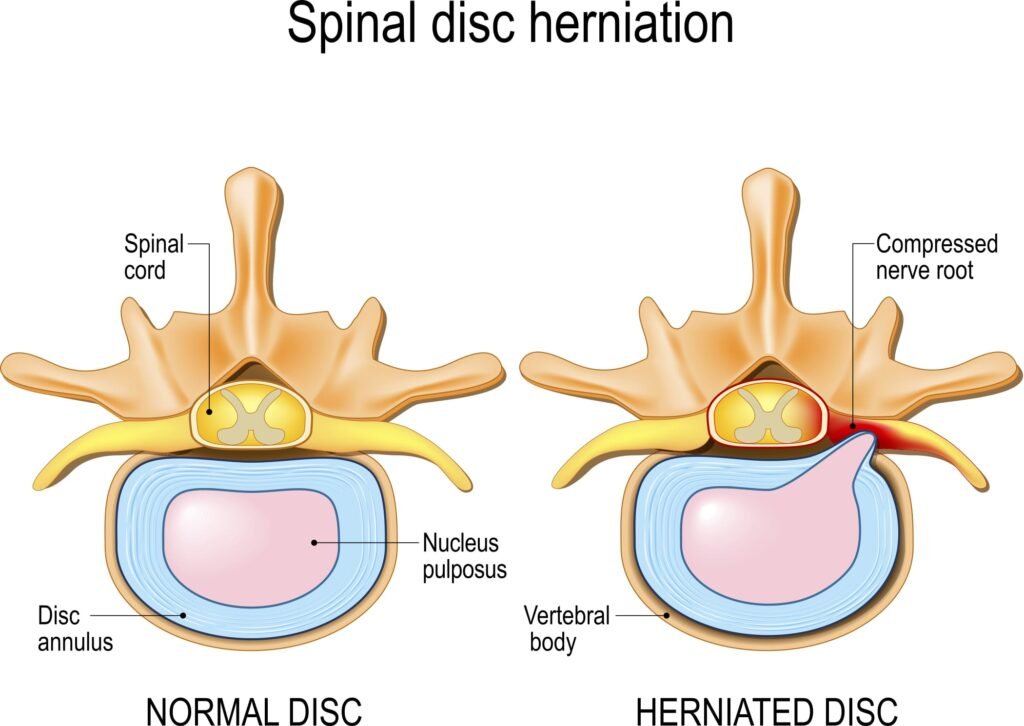
Disc Prolapse
Disc prolapse, also known as a slipped disc or herniated disc, is a condition in which the soft inner part of a spinal disc bulges through its outer fibrous layer. This may compress nearby nerves and cause lower back pain, sciatica, numbness or weakness.
Although a disc prolapse can occur anywhere in the spine, it most commonly affects the lumbar (lower back) region. Some people experience severe pain, while others may have very few or no symptoms.
At 247 Homeopathy, Zirakpur, Dr. Ruchi offers individualized homeopathic care for patients with back pain and disc-related complaints. Homeopathy should be considered as supportive care and not a replacement for emergency treatment when serious nerve compression is present.
What Is Disc Prolapse?
The spine is made up of vertebrae separated by intervertebral discs, which act as cushions and shock absorbers. These discs help support body weight and allow the spine to bend and move in different directions.
A disc has:
- Outer fibrous ring (annulus fibrosus) – provides strength and support.
- Inner soft center (nucleus pulposus) – absorbs pressure during movement.
A disc prolapse occurs when the inner nucleus pushes through the weakened outer layer, irritating or compressing nearby spinal nerves.
Causes and Risk Factors of Disc Prolapse
Several factors can weaken the disc or increase the risk of herniation.
Common Causes
- Degeneration of the disc with aging
- Weakening of the outer fibrous layer
- Repetitive bending or prolonged forward flexion
- Trauma or injury to the spine
- Heavy weight lifting
- Poor posture during prolonged sitting
- Repetitive strain on the lower back
Risk Factors
- Obesity
- Sedentary lifestyle
- Long hours of sitting
- Smoking or tobacco use
- Occupations involving repetitive lifting
- Previous spinal injury
Symptoms of Disc Prolapse
The symptoms depend on the size of the prolapsed disc and which nerve is affected.
Lower Back Pain
The most common symptom is sudden lower back pain. The pain may:
- Be sharp or severe
- Increase during bending, lifting or twisting
- Improve while lying down
- Cause stiffness in the lower back
Sciatica
Sciatica occurs when the prolapsed disc compresses the sciatic nerve.
Symptoms include:
- Pain radiating from the lower back into the buttock
- Pain travelling down the back of the thigh
- Calf pain
- Tingling or burning sensation
- Numbness in the leg or foot
Nerve Compression Symptoms
Depending on the affected nerve, a person may experience:
- Numbness of the buttock
- Tingling in the leg
- Foot numbness
- Weakness of the lower limb
- Difficulty walking
- Reduced reflexes
Cauda Equina Syndrome – A Medical Emergency
A severe disc prolapse can rarely compress the bundle of nerves called the cauda equina. This requires immediate emergency medical attention.
Warning Signs
Seek urgent medical care if you develop:
- Severe lower back pain with leg weakness
- Loss of bladder control
- Difficulty passing urine
- Loss of bowel control
- Numbness around the buttocks or genital area
- Loss of sensation in the inner thighs
- Progressive weakness in both legs
Early treatment is essential because delayed treatment may lead to permanent nerve damage.
Complications of Disc Prolapse
If nerve compression becomes significant, complications may include:
- Persistent lower back pain
- Difficulty performing daily activities
- Chronic sciatica
- Weakness of the legs
- Difficulty walking
- Problems controlling bladder or bowel function
- Loss of sensation in the lower limbs
Diagnosis of Disc Prolapse
Diagnosis begins with a detailed history and physical examination.
MRI Scan
MRI is the most useful imaging test for identifying:
- Disc prolapse
- Nerve compression
- Size and location of the herniated disc
CT Scan
A CT scan may be used when additional evaluation of the spine is required.
X-ray
An X-ray does not diagnose a slipped disc, but it may help identify fractures, spinal alignment problems or other bony conditions.
CT Myelogram
A CT myelogram may sometimes be advised to evaluate the location and extent of nerve compression.
Precautions and Lifestyle Tips
Lifestyle measures can help reduce strain on the spine and support recovery.
Do:
- Maintain good sitting posture.
- Lift objects by bending the knees rather than the back.
- Keep body weight within a healthy range.
- Perform back-strengthening exercises as advised by a healthcare professional.
- Take breaks during prolonged sitting.
- Sleep on a supportive mattress if recommended.
Avoid:
- Heavy lifting without proper technique
- Sudden twisting movements
- Prolonged sitting in one position
- Smoking or tobacco use
- Ignoring persistent numbness or weakness
If pain becomes severe or neurological symptoms develop, seek medical evaluation rather than continuing strenuous activity.
Homeopathic Treatment Approach for Disc Prolapse
At 247 Homeopathy, Dr. Ruchi selects homeopathic medicines according to the patient’s individual symptoms, nature of pain, nerve involvement and overall constitution.
The following remedies are from Dr. Ruchi’s original clinical notes.
Aesculus Hippocastanum
Aesculus is traditionally considered for lower back and sacral pain associated with stiffness and weakness. The original description includes pain aggravated by walking or stooping, with a feeling that the back may give way.
Agaricus Muscarius
Agaricus is traditionally considered when burning, shooting pain travels along the spine with marked sensitivity of the back and stiffness during bending.
Bryonia
Bryonia is traditionally considered for back pain following over-lifting or injury. The original description emphasizes sharp lumbar pain that becomes worse with movement and improves with rest or lying down.
Hypericum
Hypericum is traditionally considered for nerve pain radiating from the spine into the limbs. Dr. Ruchi’s original notes describe sharp pain due to nerve compression with tenderness of the spine and coccyx.
Frequently Asked Questions About Disc Prolapse
1. Can a slipped disc cause pain in the hip or buttock?
Yes. A lumbar disc prolapse can cause pain in the lower back, buttock, hip, or leg, particularly when a nearby nerve is irritated or compressed.
2. Can a slipped disc cause leg numbness or tingling?
Yes. Nerve irritation from a disc prolapse can cause numbness, tingling, or a pins-and-needles sensation that may extend into the buttock or leg.
Consult 247 Homeopathy in Zirakpur
If you are suffering from lower back pain, sciatica, numbness or recurrent disc prolapse symptoms, consult Dr. Ruchi at 247 Homeopathy, Zirakpur, Punjab for an individualized homeopathic assessment.
The consultation includes evaluation of your symptoms, pain pattern, nerve involvement and overall health before selecting a personalized homeopathic approach.
Clinic: 247 Homeopathy, Zirakpur, Punjab Consultation: In-clinic and online appointments available.


